
AI Overview
PRP and GFC are advanced, non surgical treatments used to support existing hair follicles and manage hair thinning. PRP uses platelet rich plasma containing natural growth factors, while GFC delivers a concentrated growth factor preparation. The right treatment depends on the cause and severity of hair loss, scalp health, and individual needs. A professional consultation can help determine whether PRP or GFC is the more suitable option.
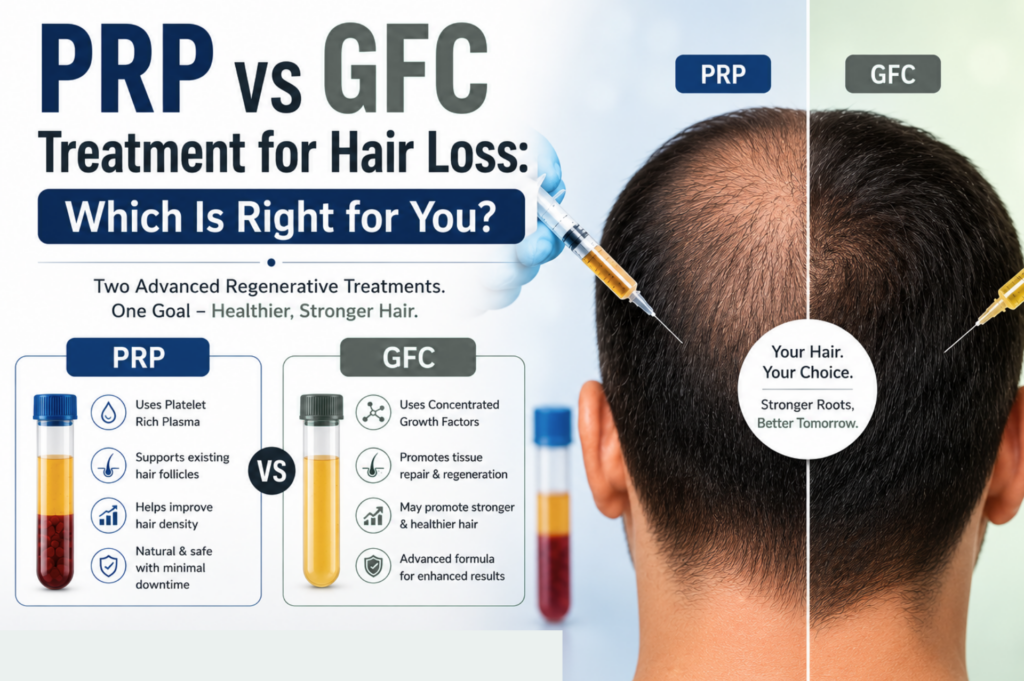
PRP vs GFC Treatment for Hair Loss: Which Is Right for You?
Hair loss and hair thinning are common concerns that can affect people of different ages. Whether caused by genetics, hormonal changes, stress, nutritional deficiencies, or other factors, ongoing hair loss can affect both appearance and confidence. Today, advanced non surgical treatments such as Platelet Rich Plasma (PRP) and Growth Factor Concentrate (GFC) are increasingly used to support hair growth and improve the health of existing hair follicles.
Although both treatments use components derived from the patient’s own blood, PRP and GFC differ in their preparation, composition, and treatment approach. Understanding the difference between PRP and GFC can help you make a more informed decision with the guidance of a qualified hair specialist.
What Is PRP Hair Treatment?
Platelet Rich Plasma, commonly known as PRP, is a non surgical hair treatment that uses a concentrated portion of your own blood. A small blood sample is processed to separate platelet rich plasma, which contains naturally occurring growth factors.
The prepared PRP is injected into areas of the scalp affected by hair thinning or reduced density. It may help support existing hair follicles and promote a healthier environment for hair growth. If you are looking for the best PRP treatment in Kanpur, a consultation with a qualified hair specialist can help determine whether PRP is suitable for your hair loss concerns.
What Is GFC Hair Treatment?
Growth Factor Concentrate, or GFC, is another regenerative approach for managing hair thinning. It uses growth factors obtained from the patient’s own blood through a specialized preparation process.
The objective of GFC is to prepare a concentrated growth factor solution that can be administered to areas of the scalp affected by hair thinning. These growth factors may help support the scalp environment and existing hair follicles.
GFC is generally performed through small injections across the targeted areas. The exact preparation and treatment protocol can vary depending on the system and clinical approach used by the practitioner.
PRP vs GFC Treatment for Hair Loss: What Is the Difference?
While PRP and GFC share the goal of supporting existing hair follicles, there are several differences between them.
Preparation Process
PRP involves processing a blood sample to separate platelet rich plasma. The final composition can depend on the equipment, preparation technique, and protocol used.
GFC uses a specialized process designed to obtain a concentrated growth factor preparation. This makes the treatment approach different from conventional PRP.
Composition
PRP contains platelets, plasma, and naturally occurring growth factors. The concentration of these components can vary according to the preparation method.
GFC focuses primarily on obtaining a growth factor rich concentrate. The treatment is designed to deliver these growth factors to targeted scalp areas.
Treatment Approach
Both procedures involve injections into the scalp, but their preparation methods and protocols are different. The choice may depend on the patient’s hair loss pattern, follicular condition, and overall treatment objectives.
Suitability
PRP and GFC may be considered for certain types of hair thinning and pattern hair loss. However, neither treatment is suitable for every person or every type of hair loss. A professional scalp evaluation is important before deciding on treatment.
How Does PRP Work for Hair Loss?
PRP therapy uses the patient’s own platelets and growth factors to support the environment around the hair follicles. After the prepared plasma is injected into the scalp, the growth factors may contribute to cellular activity around existing follicles.
The primary goal is to support follicles that are still capable of producing hair. PRP is therefore generally more suitable when hair follicles remain active rather than areas where follicles have been permanently lost.
Results can differ from one individual to another depending on genetics, the cause and severity of hair loss, age, scalp health, nutritional factors, and other conditions.
How Does GFC Work for Hair Loss?
GFC treatment aims to deliver a concentrated preparation of growth factors directly into areas affected by hair thinning. These growth factors may help create a supportive environment for existing follicles.
The treatment usually involves multiple small injections across the scalp. Depending on the individual’s condition, the dermatologist may recommend a series of sessions followed by maintenance treatments.
Like PRP, GFC is primarily intended to support existing hair follicles. It cannot be expected to recreate follicles that have been permanently destroyed.
Benefits of PRP and GFC Treatment
Both PRP and GFC may offer several potential benefits when recommended appropriately.
- They use blood derived material from the patient’s own body.
- They are non surgical hair treatments.
- Treatment sessions are generally relatively short.
- They can be included in personalized hair loss management plans.
- They may support the health and activity of existing hair follicles.
- They may be combined with other hair loss treatments when clinically appropriate.
- They require no major surgical recovery period.
Individual outcomes can vary, and these treatments should not be viewed as guaranteed solutions for every form of hair loss.
Are PRP and GFC Safe?
PRP and GFC are minimally invasive procedures when performed by a trained professional using appropriate techniques. Because the material is derived from the patient’s own blood, these treatments are generally designed to minimize concerns associated with foreign substances.
Some people may experience temporary redness, mild swelling, tenderness, or discomfort around the injection sites. These effects usually settle with time.
Before treatment, it is important to discuss your medical history, medications, allergies, and any existing scalp conditions with your healthcare professional.
PRP vs GFC: Which Treatment Is Right for You?
There is no universal answer to whether PRP or GFC is better. The appropriate option depends on factors such as your hair loss pattern, follicular health, scalp condition, medical history, and treatment goals.
A consultation with a qualified dermatologist in Kanpur can help identify the possible cause of your hair loss and determine whether PRP, GFC, or another treatment approach may be appropriate.
At Dermatrichs, hair and scalp concerns can be assessed as part of a personalized treatment plan. A professional evaluation can help determine the most suitable approach based on your individual needs rather than choosing a procedure solely because it is popular.
Final Thoughts
PRP and GFC can both support existing hair follicles and help manage hair thinning. The right choice depends on the cause of hair loss, scalp condition, and individual treatment goals. A professional consultation can help determine the most suitable approach for your needs.
If you are experiencing hair thinning or hair loss and are unsure whether PRP or GFC treatment is right for you, contact Dermatrichs for a professional consultation. Our team can assess your hair and scalp condition and help you explore a suitable treatment plan based on your individual needs.
